Infrastructure & Utilities procurement is entering 2026 under materially different conditions from the last decade.
Compared to the past decade, the landscape is materially transformed: demand for capital is accelerating as utility providers modernize grids, adapt to renewable mandates, and respond to the explosive energy needs of AI-driven data centers.
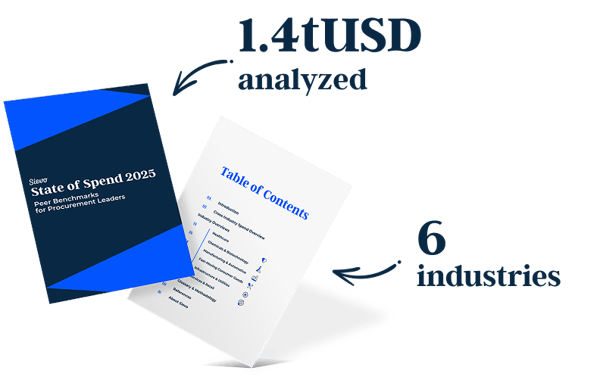
This article translates 271 bUSD of anonymized Infrastructure & Utilities procurement benchmarks from the State of Spend 2025 report into a set of KPIs for the coming year. It helps you assess:
-
How your operating metrics compare with peers
-
What gaps imply for cost, resilience, and AI readiness
- Where to prioritize improvements as the new year begins
Benchmarks describe observed performance distributions. They are not targets on their own.
What is this Infrastructure & Utilities benchmark dataset and time window?
The benchmark dataset spans a rolling period from Q3 2024 to Q2 2025, capturing anonymized, cleansed, and aggregated procurement spend.
It covers $271 billion across a representative cross-section of Infrastructure & Utilities organizations, including:
-
Electric utilities and grid operators
-
Gas, water, and district heating providers
-
Infrastructure developers and operators (ports, toll roads, airports, rail)
-
Energy and capital project owners
These firms manage capital-intensive, highly regulated assets with long investment horizons.
All benchmarks are split into top, average, and bottom performers across direct and indirect categories.
Key Shifts in Infrastructure Procurement Heading into 2026
The benchmark spend index shows steady growth, with recurring spikes in Q4.
Observed drivers include:
-
Capital programs tied to grid investment and renewables
-
Inflationary pressure across services and materials
-
Growth in HR & Benefits and Marketing
-
Year-end budget flush behavior and project completion deadlines
Deloitte's 2026 Power & Utilities Industry Outlook expects the year to be defined by delivering firm capacity under affordability pressure, with execution speed and supply resilience becoming core constraints—not just price.
What Does a Typical Infrastructure & Utilities Spend Mix Look Like?
According to the State of Spend 2025, the median Infrastructure and Utilities company looks roughly like this:
Median company signals (per $1B of spend):
-
2,500 suppliers
-
86,000 invoices
-
$11.8K spend per invoice
-
$402K spend per supplier
-
67% PO-covered spend
-
29 days invoice-to-due
Even at the median, one-third of all spend is outside PO-backed workflows. That’s not just an operational inefficiency — it’s a risk to auditability, AI readiness, and enterprise control.
Direct vs Indirect Spend: KPI Gaps and Takeaways
What separates top procurement performers from the rest in direct spend?
Direct spend outperformance is mainly structural: control and simplification.
(bottom performers → top performers)
-
PO coverage: 45% → 83%
-
Suppliers per $1B: 2,000 → 700
-
Spend per supplier: $516→ $1.4M
-
Spend per invoice: $12.7K $→ $38.4K
-
Invoice-to-due: 20 days → 37 days
A direct-spend operating model that scales through the year combines higher PO discipline, fewer suppliers, larger transactions, and more predictable payment execution.
What separates top procurement performers from the rest in indirect spend?
While direct spend gains are largely structural, indirect spend is where fragmentation and leakage introduce the most complexity — and the greatest opportunity for improvement.
(bottom performers → top performers)
- PO coverage: 42% → 82%
- Suppliers per $1B: 12,600 → 2,700
- Spend per supplier: $83K → $387K
- Spend per invoice: $4K → $12.8K
- Invoice-to-due: 24 days → 34 days
The takeaway? Indirect spend governance is not a back-office task. It’s an enterprise risk exposure and the primary lever for AI adoption, compliance, and scalability in 2026.
Where does PO leakage occur by category in indirect spend?
PO coverage, at an aggregate level, can obscure category-specific weaknesses.
The benchmark dives deeper into indirect spend and reveals massive leakage in key L2 categories:
Takeaway for 2026: Prioritize categories where top performers already demonstrate high feasibility of PO coverage. Those are typically the fastest places to tighten buying channels, reduce exceptions, and improve spend traceability.
How does working capital become a resilience lever in 2026?
One of the most tangible benefits of strong procurement execution is in working capital optimization.
If bottom performers improved their invoice-to-due cycle to top performer benchmarks, the working capital unlocked would average $37K per $1M spend.
Working capital opportunity per $1M of spend:
Takeaway for 2026: Working capital outcomes are tightly linked to procurement execution (channel discipline and contract adherence), not just negotiated terms.
How ready is Infrastructure and Utilities procurement for AI-native automation?
In 2026, procurement leaders will no longer be asking whether to use AI. The central question is how to govern AI agents.
Agentic AI systems rely on:
-
structured transaction data
-
consistent supplier and category master data
-
clear contract and pricing references
-
traceable approval workflows
The benchmark shows why this is challenging today.
Key KPIs for AI readiness:
Gains from AI only materialize when fragmentation decreases and the amount of structured data increases. The KPIs signal when the environment is ready and when it isn't.
Which KPIs matter most for Infrastructure & Utilities procurement performance in 2026?
The Infrastructure & Utilities benchmark data points to a small set of structural KPIs that consistently distinguish higher-performing procurement organizations.
Purchase Order (PO) coverage
PO coverage is a primary indicator of how much spend flows through governed purchasing channels.
If you're closer to the bottom 42% levels, you already know the pain points—maverick spend, incomplete data, and limited visibility into what's actually being purchased.
At the top level of 82%, you're not just checking a compliance box. You're building the data foundation that makes AI-driven analytics possible and gives you the spend visibility needed to drive strategic decisions.
Supplier fragmentation
Supplier fragmentation is a great indicator of administrative load indicator of administrative load, diluted leverage, and inconsistent execution.
(bottom performers → top performers)
-
Direct suppliers per $1B: 2.0k → 0.7k
-
Direct spend per supplier: $516k → $1.4m
-
Indirect suppliers per $1B: 12.6k → 2.7k
-
Indirect spend per supplier: $83k → $387k
Top performers concentrate their spend deliberately, giving them the leverage to:
-
Drive meaningful price negotiations
-
Build strategic partnerships that weather volatility
-
Co-develop solutions with key suppliers
The largest fragmentation gap is in indirect spend. For executives, this is not just a procurement efficiency issue. It is a governance and risk exposure issue across outsourced services, contractors, and operational support categories.
Transaction efficiency using spend per invoice
Spend per invoice is a practical proxy for transaction fragmentation and processing burden.
- Direct spend per invoice: $12.7k (bottom) → $38.4k (top)
- Indirect spend per invoice: $4.0k (bottom) → $12.8k (top)
Lower spend per invoice typically signals high volumes of small purchases and higher operational workload.
Leaders can use this metric to test whether procurement is positioned to scale—especially during peak periods—without drowning in transactional work.
Consider what your team could accomplish if invoice processing weren't consuming most of their bandwidth.
What is changing in Infrastructure & Utilities procurement in 2026?
Five forces are converging:
-
AI is moving from copilots to agents capable of executing work.
-
Supply chains are regionalizing under geopolitics, tariffs, and logistics disruptions.
-
AI infrastructure is intensifying competition for grid components and generation capacity.
-
Talent is shifting toward higher-value work: governance, SRM, analytics, and financial modeling.
The common thread: procurement needs a stronger structure. These benchmarks show where that structure breaks today.
Closing Questions to Shape Your 2026 Procurement Strategy
As you iterate your 2026 procurement strategy, ask yourself:
-
Are your indirect spend categories fully governed, or are they still leaking?
-
How close are you to top-quartile benchmarks?
-
Is your team spending more time on transactions than strategic execution?
-
How much working capital are you leaving unclaimed due to poor execution?
-
Can your procurement systems support scalable AI agents?
A practical next step is to benchmark your own KPIs against peers in the State of Spend report.
The full report provides the category-level industry benchmarks needed to see where focused changes in structure, process, or systems could open the next opportunity in value.