Chemicals & Biotechnology procurement teams enter 2026 with continued raw-material volatility, energy exposure, and compliance-driven overhead.
Many 2026 plans are already set; the question is whether targets and initiatives align with what peer organizations are actually achieving in process control, transaction efficiency, supplier structures, and payment-term execution.
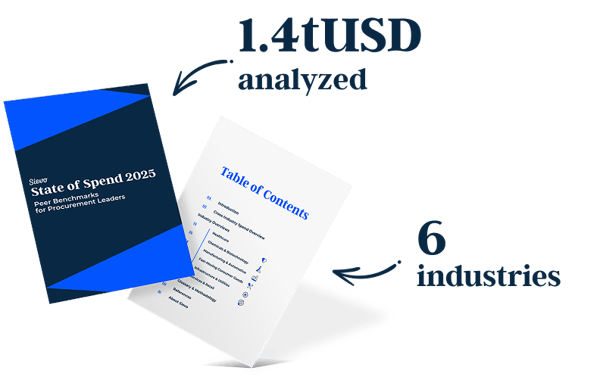
This article draws on the Chemicals & Biotechnology State of Spend benchmark dataset. The benchmarks are calculated from aggregated, anonymized, cleansed transactions covering 2024Q3–2025Q2, with ~USD 156B analyzed for this industry slice.
What does a typical chemicals procurement organization look like?”
A useful baseline is the median company profile, normalized per USD 1B of spend.
Median Chemicals & Biotechnology procurement profile (per USD 1B of spend):
- Spend mix: 70% direct / 30% indirect
- PO-covered spend: 86%
- Suppliers: ~4,000 suppliers per USD 1B of spend
- Invoices: ~106,000 invoices per USD 1B of spend
- Spend per invoice: USD 8.1K
- Spend per supplier: USD 261K
- Invoice-to-due: 38 days
This profile suggests an operating model with relatively strong control over direct materials, but significant complexity in indirect services and supplier management.
What are the best-in-class Direct Spend benchmarks in biotech?
(bottom performers → top performers)
- PO coverage: 95% → 99%
- Suppliers: 2,000 → 400 suppliers per USD 1B spend
- Spend per supplier: USD 497K → USD 2.8M
- Spend per invoice: USD 3.6K → USD 9.2K
- Invoice-to-due: 34 → 46 days
What are the best-in-class Indirect Spend benchmarks in biotech?
(bottom performers → top performers)
- PO coverage: 47% → 87%
- Suppliers: 13,600 → 4,500 suppliers per USD 1B spend
- Spend per supplier: USD 75K → USD 249K
- Spend per invoice: USD 2.4K → USD 23.8K
- Invoice-to-due: 27 → 43 days
How can procurement teams manage costs in 2026?
Cost pressure in 2026 is shaped by raw material volatility, energy exposure, and compliance-driven overhead. Benchmarks indicate that structural choices account for most of the cost-control differences.
Across both direct and indirect spend, top performers share three characteristics:
- Higher PO coverage
- Larger average invoice values
- Lower supplier counts per unit of spend
These patterns point to practical actions:
- Reducing technically redundant suppliers where qualification risk allows
- Expanding contract and catalog coverage to limit low-value transactions
- Sequencing sourcing events after consolidation to improve pricing outcomes
Takeaway for 2026: Cost optimization starts with simplification. Negotiation effectiveness improves once fragmentation and transaction noise are reduced.
How does procurement support supply chain resilience in Chemicals & Biotechnology?
In Chemicals & Biotechnology, resilience extends beyond material availability to service continuity, regulatory compliance, and supplier financial stability. Payment-term execution is a measurable differentiator.
For indirect spend, improving from bottom-performer to top-performer invoice-to-due performance corresponds to an average working capital improvement of ~USD 43K per USD 1M of spend (based on category-level differences in invoice-to-due).
Largest working capital improvement opportunities per USD 1M of spend include:
- Logistics
- Energy & Utilities
- CAPEX
- MRO
- HR & Benefits
These categories often combine high spend, decentralized buying, and inconsistent term execution.
Takeaway for 2026: Payment discipline is a lever for resilience. Improving term execution in a small number of high-impact categories can materially increase financial flexibility.
How ready is the industry for AI and automation in 2026?
AI and AI agents depend on structured procurement data. In practice, this requires:
- Spend flowing through governed processes, typically via POs
- Consistent supplier and category master data
Benchmark data shows that even organizations with strong overall PO coverage can have blind spots at the service-line level. Low-PO categories commonly include air freight, accommodation/hotels, legal services, telecommunications, and memberships/sponsorships.
These gaps reduce visibility into spend and limit the reliability of analytics and automation initiatives.
Takeaway for 2026: Treat low-PO service categories as data foundation work. Improvements in control and data quality are prerequisites for scaling AI.
Which procurement KPIs matter most for Chemicals & Biotechnology in 2026?
A Chemicals & Biotechnology procurement dashboard for 2026 should prioritize KPIs that explain cost control, risk exposure, cash flow, and digital readiness.
- Purchase Order (PO) coverage
PO coverage is a primary indicator of process control and data completeness. In regulated, asset-intensive environments, off-PO spend increases compliance risk and weakens auditability.
Higher PO coverage improves spend visibility and enables more reliable analytics, automation, and reporting.
Indirect spend benchmarks:
- Top performers: ~87% PO-covered spend
- Bottom performers: ~47% PO-covered spend
- Supplier count and spend per supplier
Suppliers per USD 1B of spend measures fragmentation at scale. Spend per supplier reflects the depth of the relationship and the supplier's negotiating power.
In Chemicals & Biotechnology, low spend per supplier often signals a long tail of low-value vendors and limited ability to enforce technical standards or sustainability requirements.
Direct spend:
- Top performers: ~400 suppliers per USD 1B | USD 2.8M per supplier
- Bottom performers: ~2,000 suppliers per USD 1B | USD 497K per supplier
Indirect spend:
- Top performers: ~4,500 suppliers per USD 1B | USD 249K per supplier
- Bottom performers: ~13,600 suppliers per USD 1B | USD 75K per supplier
Invoice-to-due
Invoice-to-due measures the time between invoice receipt and the contractual due date. Due-to-pay reflects execution against due dates (positive values indicate late payment in this report’s framing).
In Chemicals & Biotechnology, predictable payment execution supports supplier stability and unlocks working capital without renegotiating prices.
Indirect benchmarks:
Direct benchmarks:
Conclusions
Benchmarking is the next step for validating 2026 procurement plans. This article summarizes what “typical” looks like in Chemicals & Biotechnology and how top performers differ.
Use these KPIs as a common language with finance, supply chain, and business leaders to:
-
align on where performance gaps are structural (governance, consolidation, transaction design) versus commercial,
-
set realistic targets using peer benchmarks (top/average / bottom),
-
track impact through 2026 in a way that is comparable across sites, categories, and business units.
The full State of Spend report provides the benchmark values and distributions needed to determine where your procurement team is already operating at a leading level and where targeted changes are most likely to deliver the next step of measurable value.