In Services and Retail, small procurement improvements show up fast in the numbers—margins, service levels, and disruption recovery. So why do some procurement teams consistently outperform others?
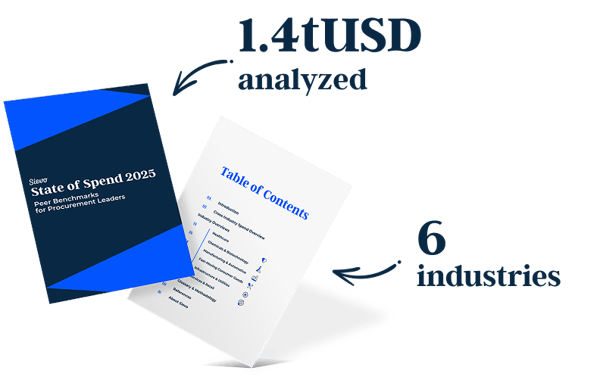
The State of Spend 2025 report provides performance benchmarks derived from $103B in procurement transactions across the Services and Retail sectors (2024Q3–2025Q2).
Understanding these differences and the operational practices that drive them is essential for procurement leaders in 2026.
What do Services & Retail procurement benchmarks show heading into 2026?
Between 2022 and 2024, Services & Retail spend increased on an inflation-adjusted basis across both direct and indirect categories. Spend levels remained elevated even as growth slowed in early 2025.
According to Kearney's 2025 H2 Supply Chain Navigator report, supply chain costs are expected to rise 4 to 7 percent above inflation by Q4 2025 when accounting for tariffs, sentiment, and other risk-based factors. For Services and Retail organizations, this structural volatility directly impacts logistics contracts, facilities management, and professional services pricing.
In Services & Retail, the hardest work is often indirect: services, logistics, facilities, IT, and professional services. These categories tend to be decentralized. They also generate many small transactions.
For planning, these benchmarks support the assumption of continued volatility in service contracts, logistics, and supplier pricing.
What is the median Services & Retail procurement profile?
Start with your current baseline for PO coverage, supplier count per $1B spend, spend per invoice, and invoice-to-due. Then compare your values to the benchmark ranges.
Focus first on the largest gaps, as they usually drive cost, risk exposure, and reporting quality.
-
Indirect vs direct spend: 64% indirect / 36% direct
-
PO-covered spend: 50%
-
Suppliers: 8,100 suppliers per $1B spend
-
Invoices: 269,000 invoices per $1B spend
-
Spend per invoice: $3.7K
-
Spend per supplier: $123K
-
Invoice-to-due: 27 days
These numbers point to a service-heavy model with high transaction volume and a large supplier footprint.
What are the key Direct Spend procurement benchmarks in Services & Retail?
(bottom performers → top performers)
-
PO coverage: 23% → 75%
-
Suppliers: 20,000 → 5,900 suppliers per $1B spend
-
Spend per supplier: $50K → $183K
-
Spend per invoice: $0.8K → $3.1K
-
Invoice-to-due: 18 → 40 days
What are the key Indirect Spend procurement benchmarks in Services & Retail?
(bottom performers → top performers)
-
PO coverage: 7% → 64%
-
Suppliers: 14,600 → 6,500 suppliers per $1B spend
-
Spend per supplier: $69K → $155K
-
Spend per invoice: $2.0K → $9.4K
-
Invoice-to-due: 23 → 31 days
How can Services & Retail procurement teams control costs in 2026?
Inflation and higher interest rates raise service contract pricing and supplier costs. The fastest way to respond is to reduce fragmentation and increase buying control.
Benchmark differences between top and bottom performers show how structure influences cost control.
Direct Spend benchmarks (bottom → top performers):
-
PO coverage: 23% → 75%
-
Spend per invoice: $0.8K → $3.1K
-
Suppliers: 20,000 → 5,900 suppliers per $1B spend
Higher-performing procurement organizations issue fewer invoices, work with fewer suppliers, and route more spend through governed channels. Practical actions that map to these benchmarks:
- Reduce tail spend by consolidating low-value suppliers
- Expand catalog and contract coverage to lift spend per invoice
- Run competitive sourcing more often in volatile categories
- Use PO policy to curb maverick buying
Takeaway for 2026: Prioritize actions that reduce fragmentation first. Negotiations work better after you simplify the supplier base and channels.
How to build supply chain resilience in services and retail procurement?
Risk in 2026 is not only physical supply risk. It is a service continuity risk. It is also a risk to the contract execution.
One area with clear benchmark impact is payment behavior. In indirect spend, improving from a bottom-performer to a top-performer invoice-to-due performance can release 34k USD per 1M USD of spend in working capital.
The dataset shows large category-level cash potential (per 1M USD of spend), including:
These categories are also common sources of decentralized buying and contract exceptions.
Takeaway for 2026: Working capital improvement is a resilience move. It gives the business room to absorb shocks. Pick two or three categories with the biggest cash upside and tighten term execution there first.
How ready is Services & Retail procurement for AI and automation in 2026?
AI and automation depend on structured procurement data. In practice, that means two things:
- Spend is captured through governed workflows (often via POs)
- Transactions are coded consistently (supplier and category master data)
When PO coverage is low, a large share of spend is missing from the controlled data stream. That reduces visibility and makes analytics and automation less reliable.
In the benchmark dataset, bottom-performer indirect PO coverage at the L3 level is close to zero in several common service lines:
-
Telecom (IT): 3% PO coverage
-
Financial Services (Professional Services): 1% PO coverage
-
Market Research (Marketing): 1% PO coverage
-
Travel (Travel): 0% PO coverage
Takeaway for 2026: Make low-coverage categories your first “AI readiness” projects. Increase PO usage and clean the data before you scale AI use.
Which procurement KPIs matter most for Services & Retail in 2026?
A 2026 procurement dashboard should focus on KPIs that explain cost control, risk exposure, cash flow, and digital readiness.
In Services & Retail, a small set of structural metrics consistently separates top performers from the rest.
Purchase Order (PO) coverage
In Services & Retail procurement, PO coverage is one of the strongest indicators of process control and data quality.
Services and contract spend often escape governed channels.
Low PO coverage also limits the usefulness of analytics and AI.
Raising PO coverage is a great lever to improve spend visibility and reporting quality.
Supplier count and spend per supplier
Suppliers per $1B spend measures supplier fragmentation at scale. Across industry procurement benchmarks, supplier count per $1B spend is a reliable signal of fragmentation and operating risk.
High fragmentation weakens leverage, increases onboarding workload, and raises risk exposure across outsourced services and retail operations.
Excess supplier counts increase risk exposure, dilute leverage, and complicate oversight.
Spend per supplier indicates the depth of the relationship and the negotiating leverage. In Services & Retail, low spend per supplier often means a long tail of low-value vendors and a weaker ability to enforce SLAs and terms.
Direct spend:
-
Top performers: 5,900 suppliers per $1B spend | $183K spend per supplier
-
Bottom performers: 20,000 suppliers per $1B spend | $50K spend per supplier
Indirect spend:
-
Top performers: 6,500 suppliers per $1B spend | $155K spend per supplier
-
Bottom performers: 14,600 suppliers per $1B spend | $69K spend per supplier
If you're managing 1,100+ suppliers per billion in direct spend, you know the challenge: you're spread too thin to negotiate effectively or collaborate on specification improvements.
Top performers concentrate their spend deliberately, giving them the leverage to:
-
Drive meaningful price negotiations
-
Build strategic partnerships that weather volatility
-
Co-develop solutions with key suppliers
The gap is even wider in indirect spend. Ask yourself: are you managing suppliers, or are they managing you.
Invoice-to-Due
Invoice-to-due measures the time between invoice receipt and the due date. Invoice-to-due reflects how reliably organizations can execute payment terms. In Services & Retail, predictable payment terms support supplier stability and give finance more control over working capital.
The business case is compelling: improving from the bottom to the top quartile in invoice-to-due timing for indirect spend delivers approximately 34k USD in working capital improvement per $1M of spend. At scale, that's board-level impact.
Indirect benchmarks:
Direct benchmarks:
Conclusions for 2026
Services & Retail procurement in 2026 will be shaped by structural cost pressure, service-heavy spend, and high supplier fragmentation.
As you refine your 2026 plan, pressure-test it with a few industry-specific questions:
-
Where is PO coverage lowest in indirect spend, and which categories drive most off-PO buying?
-
Which categories have the highest supplier fragmentation per $1B spend, and which suppliers can be consolidated safely?
-
Where is spend per invoice lowest, indicating many small transactions and high processing cost?
-
Are invoice-to-due and due-to-pay outcomes stable, or are exceptions creating late payments and supplier friction?
-
Do we have enough structured data (POs, clean supplier master data, consistent categories) to scale automation and AI?
A practical next step is to benchmark your KPIs against Services & Retail peers in the State of Spend report and set 2026 targets based on the results.
Organizations that close these gaps gain better cost control, stronger supplier relationships, improved cash flow, and a data foundation that supports automation and AI.