Find out how leading procurement teams in healthcare and pharma are managing rising spend, tighter markets, and get new benchmarks for efficiency and control in 2026.
Updated: Jan 14, 2026
Healthcare and pharma procurement teams enter 2026 with rising spend, volatile supply markets, and higher expectations for performance.
For leaders, a good starting point for a new year is a procurement benchmarking report that shows how your KPIs compare with peers and where procurement benchmarks are actually being met.
The State of Spend Report, based entirely on real purchase orders, invoices, and supplier transactions, gives a unique view of how the industry actually operates. What's changing and where industry leaders outperform?
This article summarizes the trends, benchmarks, and KPIs procurement leaders most frequently look for as they plan 2026.
Full details, including category-level KPIs and distributions for top, average, and bottom performers in healthcare industry, are available in the complete State of Spend procurement benchmarking report.
Why is healthcare procurement spend increasing?
Total healthcare spend has risen steadily since COVID-19 and remains above the 2022 Q1 baseline on an inflation-adjusted basis for both direct and indirect categories.
Key structural drivers are visible in the data and in the wider market:
- Insurance consolidation continues to put upward pressure on prices for many services.
- Heavy investment in healthcare IT, fuelled by near-record private equity funding
Even small categories are strategic priorities. Fleet spend, for example, accounts for roughly 0.6% of revenue, but about 52% of that spend goes to fleet management services, signalling fleet modernization rather than simple operating cost (State of Spend, 2025).
Takeaway for 2026: Treat cost pressure as structural. Plans for 2026 should assume sustained spend growth rather than a return to pre-2022 levels.
How is AI changing procurement in the healthcare industry?
AI adoption accelerated through 2025,
but the State of Spend data shows that results depend on digital maturity. Organizations that meet or exceed procurement best practices benchmarks in process design capture more AI value.
Common traits of higher-performing, AI-ready procurement functions:
- Higher PO coverage across major categories
- Fewer invoices per 1 bUSD of spend, especially in direct materials
- Higher spend per invoice, indicating consolidated and well-designed purchasing.
- Lower supplier counts per 1 bUSD, indicating less fragmentation
In other words, AI performs best where processes are already standardized and data is structured. Where spend is fragmented, and PO discipline is weak, the same tools deliver much less impact.
Takeaway for 2026: AI amplifies well-structured procurement processes, but it does not fix fragmentation. Strengthen PO discipline, master data, and category governance before scaling AI.
How can Payment Terms help procurement improve working capital?
Payment-term discipline is one of the fastest, most scalable levers for working-capital gains.
According to the State of Spend 2025 dataset, moving from bottom-performing payment behavior to best-in-class execution can unlock around 65k USD in working capital per 1M USD of spend.
This improvement comes from:
- More consistent payment-term execution
- Better supplier segmentation
- Clearer prioritization of early-pay or extended-term strategies
Small shifts in average days to pay, applied consistently across large spend bases, convert into meaningful cash benefits.
Direct Spend Payment Terms
Based on real transaction data (2024Q3–2025Q2), Healthcare companies show the following Direct Invoice-to-Due performance:
- Top Performers: 65 days
- Average Performers: 56 days
- Bottom Performers: 47 days
Indirect Spend Payment Terms
Indirect categories show wider performance spreads, reflecting more variability in terms of discipline:
- Top Performers: 46 days
- Average Performers: 40 days
- Bottom Performers: 28 days
Category-Level Payment Term Benchmarks and Impact
The table below summarizes the payment terms by L2 Category and working capital improvement opportunities in Healthcare.
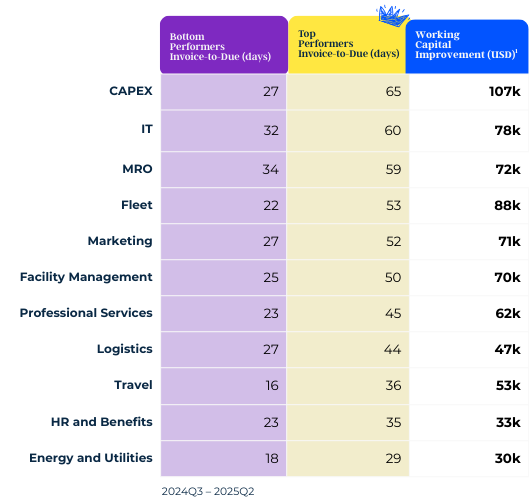
Takeaway for 2026: Payment terms will likely play a larger role in cash-flow management than in prior years. Treat payment terms as an integral part of the healthcare and pharma procurement strategy, not just a finance concern.
Which KPIs matter most for managing procurement performance in 2026?
The 2025 State of Spend dataset highlights a group of procurement KPIs that consistently separate top-performing teams from the rest.
These metrics have the strongest impact on cost, cash flow, process efficiency, and resilience.
1. Purchase Order (PO) coverage
PO coverage is one of the clearest indicators of procurement process control.
Higher PO coverage is strongly associated with:
- Better spend data quality
- Fewer exceptions and off-PO purchases
- More predictable financial and budgeting outcomes
For healthcare and pharma procurement in 2026, high PO coverage means critical spend flows through governed channels, reducing compliance risk. Using governed channels also supports audit readiness and provides finance and leadership with a reliable view of costs amid ongoing price pressure and regulatory scrutiny.
L2 Category Level PO Coverage
Across major indirect categories, the State of Spend shows:
- Energy & Utilities:
- Top performers: 88%
- Bottom performers: 27%
- IT:
- Top: 98%
- Bottom: 32%
- Marketing:
- Top: 97%
- Bottom: 18%
- Fleet:
- Top: 97%
- Bottom: 25%
- HR & Benefits:
- Top: 78%
- Bottom: 21%
- Facility Management:
- Top: 93%
- Bottom: 40%
- Professional Services:
- Top: 48%
- Bottom: 20%
- Logistics:
- Top: 38%
- Bottom: 15%
- Travel:
- Top performers: 27%
- Bottom performers: 25%
- MRO:
- Top: 98%
- Bottom: 41%
These differences show where operational discipline is strongest (e.g., MRO, IT) and where unmanaged or spot buying remains common (e.g., Professional Services, Logistics).
L3 Level Deep Dive
The granular L3 cut provides a clearer sense of how inconsistent process use can be at the line-item level:
- Logistics
- Intermodal Freight: 2.9% PO coverage
- Warehousing & Storage: 98%
- Energy & Utilities
- Electricity: 12%
- Gasoline, Petro, Diesel: 100%
- IT
- Telecommunications: 36%
- IT Hardware: 99%
- Facility Management
- Rent & Lease: 20%
- Construction Services: 100%
- Fleet
- Fuel: 1%
- Fleet Management Services: 100%
- Professional Services
- Financial Services: 6%
- Technical Services: 99%
- Marketing
- Market Research: 43%
- Advertising: 100%
- Travel
- Air Travel: 1%
- Meetings & Events: 90%
Categories with low PO coverage often correspond to fragmented supplier bases, decentralized buying behavior, or unclear intake channels.
As healthcare organizations prepare for another year of cost pressure, these gaps are where procurement can tighten process control with relatively low friction.
Raising L2 and L3 coverage even modestly improves auditability and provides cleaner data for category strategy, forecasting, and payment-term execution.
3. Spend per invoice
Spend per invoice captures how well categories and buying channels are designed and governed.
Higher spend per invoice usually indicates:
- More structured and consolidated purchasing models
- Better catalog and contract utilization
- Lower transactional workload for the same level of spend
In 2026, this KPI matters because organizations need scalable purchasing models that absorb inflation and volatility without adding manual workload.
Higher spend per invoice signals that guided buying, catalogs, and contracts are working, which frees capacity for category strategy, supplier risk work, and collaboration with CMOs, CROs, and other strategic partners.
From a benchmark perspective, the State of Spend 2025 Healthcare dataset shows a clear spread in Direct Spend per Invoice between performance tiers.
Top-performing Healthcare companies reach an average Direct Spend per Invoice of 6.4k USD, median performers sit at 3.6k USD, and bottom performers at 1.5k USD.
4. Number of suppliers
The number of active suppliers directly affects risk and leverage. The median remains high, especially compared with more consolidated industries.
This KPI influences:
- Supplier risk exposure
- Negotiating power and price consistency
- Supplier management and onboarding overhead
In the State of Spend dataset, top performers operate with around 0.6k suppliers per 1b USD of spend and an average 1.6m USD spend per supplier in Direct Spend.
Average performers manage roughly 1.3k suppliers per 1b USD (about 798k USD per supplier), while bottom performers are up at 2k suppliers per 1b USD, with only 486k USD per supplier.
On Indirect Spend, fragmentation is more visible. For top performers, roughly 8.1k suppliers handle each 1b USD of spend, translating to about 126k USD per supplier.
At the average level, 1b USD is spread across about 13.3k suppliers, dropping the figure to roughly 75k USD per supplier.
For bottom performers, the same 1b USD is split among around 19.3k suppliers, so only about 52k USD flows through each supplier.
Supply markets are still exposed to geopolitical tension, logistics volatility, and tightening quality requirements. A large, fragmented supplier base makes it harder to monitor risk, maintain consistent pricing, and keep up with qualification and oversight.
5. Invoice-to-due timing
Invoice-to-due timing links operational speed with cash discipline. It is particularly important in categories where payment terms are strategic.
This KPI helps you understand:
- How quickly invoices are captured and approved.
- How reliably payment terms are executed.
- The room you have to optimize early-pay discounts or extended terms
In 2026, boards are pushing harder on working capital while suppliers ask for reliability and, in some cases, faster cash to cope with their own cost and financing pressures.
Stable invoice-to-due timing lets healthcare and pharma companies manage cash deliberately without signalling risk or unreliability to critical partners.
Conclusion
A practical next step is to benchmark your own KPIs against industry peers in the State of Spend report.
Using these KPIs as a common language with finance, supply chain, and business leaders makes it easier to agree on priorities, track impact during 2026, and adjust as markets move.
The full State of Spend report provides the benchmarks and distributions needed to decide where procurement is already leading and where targeted changes can unlock the next step of value.
Get real insights from 1.4tUSD in spend analyzed!
Claim your copy now to get access to benchmarks, industry trends, and expert recommendations you can't find anywhere else.
Related Articles